
The Complete Guide to Natural Oils for Skin and Hair: Benefits, Uses, and Best Oils for Each Skin Type
The foundational oils for our products have been hand-selected to perform specific functions for the continued health and vitality of your skin and hair. We're written so much about this important area over the years we've been in business, it only makes sense to talk about the difference between them and explore some of the past topics on this often-searched question!
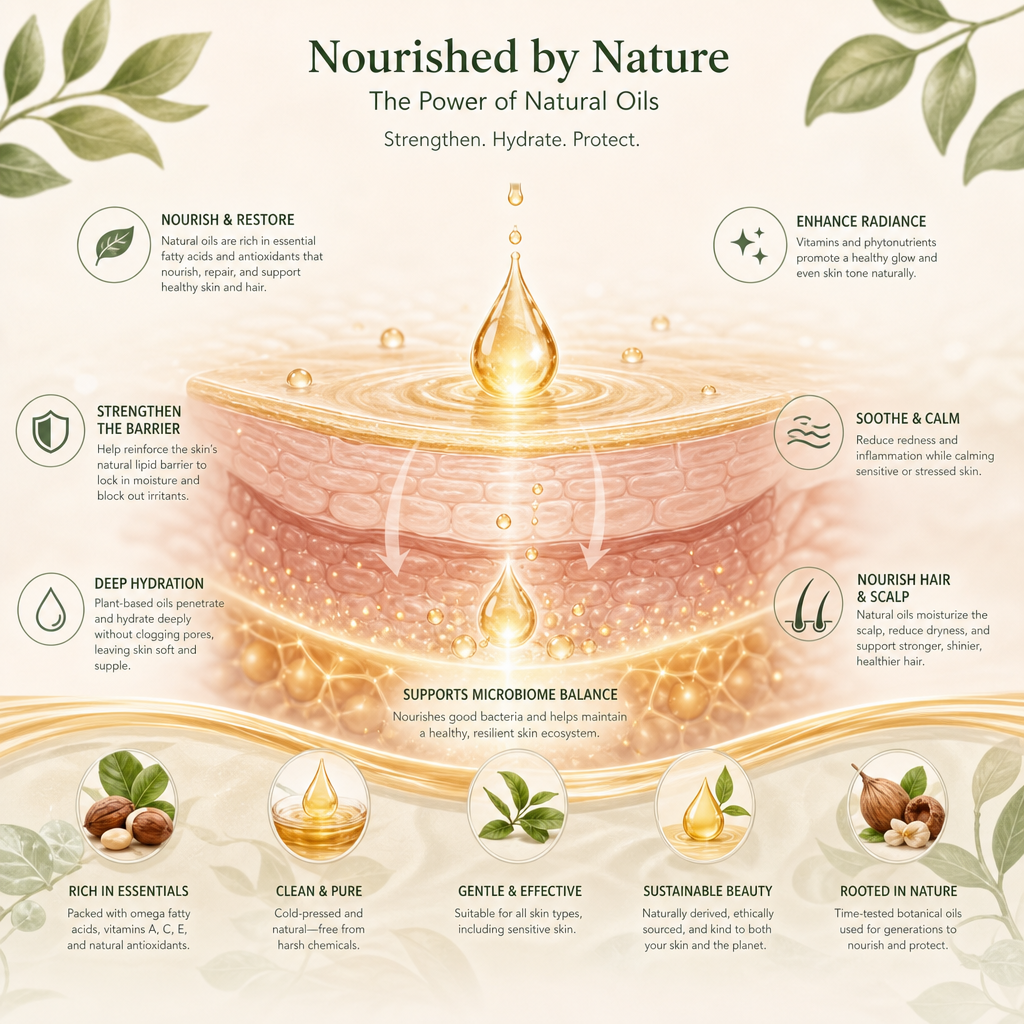 There are two basic types of oils you will often see referenced in the beauty and self care arena. Base (carrier) oils and essential oils get lumped together all the time, but they’re actually completely different categories of ingredients — different chemistry, different uses, different strengths, and different safety considerations.
Understanding the difference is especially important if you're interested in clean‑ingredient brands like ours, because our products rely heavily on carrier oils (jojoba, apricot kernel, coconut) and only lightly on essential oils.
Base or Carrier Oils
Carrier oils are fatty, nourishing plant oils pressed from nuts, seeds, or fruits. Examples: jojoba, macadamia, kukui, argan, sweet almond, grapeseed, sunflower.
What they’re made of
Carrier oils are composed of:
-
Fatty acids (omega‑3, 6, 7, 9)
-
Vitamins (A, E, sometimes C)
-
Antioxidants
-
Lipids that mimic skin’s natural oils
These components make them moisturizing, barrier‑supportive, and gentle.
What they can do
-
Moisturize and soften skin
-
Support the moisture barrier
-
Reduce dryness and flakiness
-
Calm irritation
-
Help balance sebum
-
Dilute essential oils to safe levels
They’re safe to use directly on the skin because they’re non‑volatile and non‑irritating (unless someone has a nut allergy).
Essential Oils: What They Are & Why They’re Different
Essential oils are highly concentrated plant extracts obtained through steam distillation or cold pressing (like citrus peels).
Examples: lavender, peppermint, tea tree, lemon, frankincense essential oil.
What they’re made of
Essential oils contain:
-
Volatile aromatic compounds
-
Terpenes
-
Esters
-
Phenols
-
Aldehydes
These compounds give essential oils their strong scent and therapeutic properties — but also their potential to irritate skin.
What they do
-
Provide fragrance
-
Offer antimicrobial or antifungal benefits
-
Can help with mood, relaxation, or focus
-
May support scalp health (tea tree, peppermint)
But they do not moisturize - they contain no fatty acids.
Safety considerations
Essential oils:
-
Must be diluted in a carrier oil
-
Can irritate sensitive skin
-
Can disrupt the skin barrier if overused
-
Can cause allergic reactions
-
Should be used sparingly in facial products
Butters and Waxes: What Are They, and Why are They Different?
Some oils are classified as “butters” or “waxes” because of their chemical structure, fatty‑acid profile, and melting point - not because they’re fundamentally different from oils. The beauty and health industry uses these terms to describe how the ingredient behaves at room temperature and how it performs on skin or hair.
Oils are liquid at room temperature. They flow easily so they won't clog narrow tubes or other methods of dispensary. They also have a low melting point and will spready very easily on the skin and other surfaces that are porous, allowing them to absorb more easily (although this definitely varies per oil also).
Butters are semi-solid at room temperature. They will melt on contact with the skin since our skin is naturally warm. They have a creamy, thicker texture that requires a bottle or jar type of storage, and they have a higher melting point than liquid oils.
Waxes are solid at room temperature. They have a high melting point. From a cosmetic standpoint, they provide protection, occlusion (keepoing other elements out) and are excellent for things like lip balms. Think of bees wax as an example.
Ready to get more informed about carrier and essential oils? See below!
Carrier Oils Deep Dive:
- Why Jojoba Oil Is One of the Best Natural Oils for Acne Prone or Oily Skin
- Castor Oil: Multipurpose Skincare and Hair Growth at Your Fingertips
- Noncomedognic Oils That Don't Clog Pores or 'Mask' the Skin
- Oil Pulling for Healthier Teeth and Gums
- Why Coconut Oil is So Good for Your Skin
- Which Oils are Least Likely to Clog Pores?
- Remedies for Thinning Hair Part II | Cod Liver Oil (Non-topical hair loss remedy!)
- Magnesium Oil: Natural Deodorant and So Much More
- Oils with Natural Sunscreen Capabilities
- Macadamia vs. Kukui Oil: Which Can Work Best for Your Skin Type?
Essential Oils Deep Dive:
- Health and Beauty Uses of Oregano Oil (It's Potent, Use with Care!)
- Frankincense Oil Skin and Health Benefits
- Benefits of the Ctirus Family of Essential Oils
- Rosemary Essential Oil for Anxiety Relief and Focus
- Lemongrass Essential Oil as a Mouthwash? Potential Oral Benefits of This Inexpensive Oil
- Remedies for Thinning Hair Part IV | Rosemary Oil
- The Best Nondrying Antibacterial Essential Oils for Clear Skin
- Using Aromatherapy to Facilitate Mood and Influence Focus
- Rosemary Essential Oil Boosts Hair Growth, Dramatically Improves Scalp Health
- Lemongrass Oil – More Uses & Benefits Than Anyone Knew!
Butters and Waxes Deep Dive:
- Babassu Butter: What Is It, and How Can it Benefit Your Skin & Hair?
- Jojoba Oil: It's Actually a Wax!
- Why Jojoba Oil Is One of the Best Natural Oils for Acne Prone or Oily Skin
Related Products:
Certified Organic Undiluted Argan Oil
Natural Warm Citrus Body Lotion
FAQs:
Q: What is the difference between carrier oils and essential oils?
A: Carrier oils are oils that are typically pressed from a nut or seed, resulting in a larger output of raw material oil than essential oils. They are used as bases, or as 'carriers' for more concentrated, bioactive ingredients such as essential oils or other active ingredients like panthenol or vitamin C.
Essential oils are typically extracted using steam distillation or other more intensive methods since they are much harder to extract mechanically from the raw component they come from (example, orange essential oil comes from the peel of the orange, or rosemary oil is extracted from the hard spiny leaves of the plant). They are typically much more bioactive and concentrated, and therefore must be diluted before topical use on skin. When using for skin or hair care, it is important the essential oil is "therapeutic grade".
Q: Why are organic oils recommended?
A: Organic is always better and the preferred option if you don't mind paying a bit more. For carrier oils especially, when you are spreading a large amount of something onto your skin or scalp, it is preferred it be organically grown and free of pesticides. If you're looking for the cleanest skin and hair care possible, look for organic carrier or base oils in the ingredient label sicne they can make up a lot of the formula's foundation.
Q: Can I use oils on my facial skin even if I'm prone to acne?
A: The answer that surprises everyone is yes. Even if your skin is acne-prone, there are several lighter, less oclusive oils you can use that are perfectly appropriate for acne-prone skin. To name just a few: Apricot kernel oil, argan oil, jojoba oil, and rosehip oil.
Q: Can I only use oils on my face at night, or are they compatible with makeup or daytime use?
A: You can use some oils during the day and under makeup or for general daytime use, but generally if you're using the oil by istelf, and not as part of a cream or lotion, it's best to use most oils at night on your facial skin.
This allows them to sink in appropriately, and does not interfere with makeup or sunscreen. Not only that, the oil's natural bioactive components have the opportunity to sink in deeper at night since our body's temperatures naturally elevate, increasing absorption.
Q: Why are natural oils better than synthetic wetting agents in skincare?
A: Real oils are bioactive, and they nourish and to some degreen, protect the skin with their vitamin and fatty acid constituents.
Wetting agents are typically man-made in a lab or factory. They do not contain natural compounds, and are more likely to act as a masking agent on the skin, rather than a microbiome-friendly companion.
Q: Which oils are least likely to cause a reaction if my skin is sensitive?
A: The best oils for sensitive or reactive skin are those that don't interfere with the aforementioned microbiome, or natural ecosystem of the skin's surface. The skin's surface, much like your digestive system, is home to friendly and protective bacteria and fungi. But also important is choosing oils that do not have components known to cause interactions in certain people. Examples of oils friendly to sensitive skin are: Jojoba, rosehip, sea buckthorn and argan oils.
Q: Why are some oils classified as "butters" or "waxes"?
A: Think about it this way: It's all about how the oil in question behaves (consistency-wise) at room temperature, but not only that, it also has to do largely to its chemical structure. For instance, raw coconut oil that is not alterered in any way, is technically a solid consistency. If it even tips the scale a little into warmer environments, it instantly becomes a liquid oil. Yet it is still called an oil because its chemical structure is that of a triglyceride. This just means that it consists mainly of fatty acids. Oils like jojoba are technically waxes because of their sebum-like, very absorbable consistency, but because they are liquids at even slightly above room temperature, for ease of classification, they are called a 'wax". It's a little confusing, but you can kind of see how these classifications work when you really look at the chemical makeup and behavior of the oils you're interested in.